


Create Signals#
This section describes how to create new signals from various mathematical models.
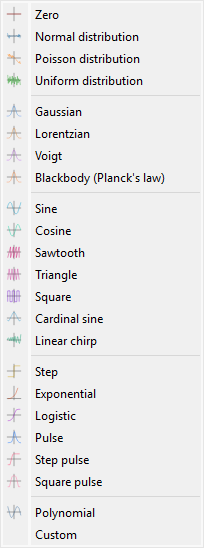
Screenshot of the “Create” menu.#
When the “Signal Panel” is selected, the menus and toolbars are updated to provide signal-related actions.
The “Create” menu allows you to create new signals from various models (see below).
New signal#
Create a new signal from various models:
Icon |
Model |
Equation |
|---|---|---|

|
Zero |
\(y[i] = 0\) |

|
Normal distribution |
\(y[i]\) is normally distributed with configurable mean and standard deviation |

|
Poisson distribution |
\(y[i]\) is Poisson distributed with configurable mean |

|
Uniform distribution |
\(y[i]\) is uniformly distributed between two configurable bounds |

|
Gaussian |
\(y = y_{0}+A \cdot \exp\left(-\dfrac{1}{2} \cdot \left(\dfrac{x-\mu}{\sigma}\right)^2\right)\) |

|
Lorentzian |
\(y = y_{0}+\dfrac{A}{1+\left(\dfrac{x-\mu}{\sigma}\right)^2}\) |

|
Voigt |
\(y = y_{0}+A \cdot \dfrac{\Re\left(w(z)\right)}{\Re\left(w(j/\sqrt{2})\right)}\) with \(w(z) = \exp\left(-z^2\right) \cdot \erfc(-j \cdot z)\) and \(z = \dfrac{x-\mu+j \cdot \sigma}{\sqrt{2} \cdot \sigma}\) |

|
Blackbody (Planck’s law) |
\(y = \dfrac{2 h c^2}{\lambda^5 \left(\exp\left(\dfrac{h c}{\lambda k T}\right)-1\right)}\) |

|
Sine |
\(y = y_{0}+A\sin\left(2\pi \cdot f \cdot x+\phi\right)\) |

|
Cosine |
\(y = y_{0}+A\cos\left(2\pi \cdot f \cdot x+\phi\right)\) |

|
Sawtooth |
\(y = y_{0}+A \left( 2 \left( f x + \frac{\phi}{2\pi} - \left\lfloor f x + \frac{\phi}{2\pi} + \frac{1}{2} \right\rfloor \right) \right)\) |

|
Triangle |
\(y = y_{0}+A \sawtooth\left(2 \pi f x + \phi, \text{width} = 0.5\right)\) |

|
Square |
\(y = y_0 + A \sgn\left( \sin\left( 2\pi f x + \phi \right) \right)\) |

|
Cardinal sine |
\(y = y_0 + A \sinc\left(2\pi f x + \phi\right)\) |

|
Linear chirp |
\(y = y_{0} + A \sin\left(\phi_{0} + 2\pi \left(f_{0}\, x + \frac{1}{2} c\, x^{2}\right)\right)\) |

|
Step |
\(y = y_{0}+A \left\{\begin{array}{ll}1 & \text{if } x > x_{0} \\ 0 & \text{otherwise}\end{array}\right.\) |

|
Exponential |
\(y = y_{0}+A \exp\left(B \cdot x\right)\) |

|
Logistic |
\(y = y_{0} + \dfrac{A}{1 + \exp\left(-k \left(x - x_{0}\right)\right)}\) |

|
Pulse |
\(y = y_{0}+A \left\{\begin{array}{ll}1 & \text{if } x_{0} < x < x_{1} \\ 0 & \text{otherwise}\end{array}\right.\) |

|
Step Pulse |
\(y = \left( \begin{cases} y_0 & \text{if } x < t_0 \\ y_0 + A \cdot \dfrac{x - t_0}{t_r} & \text{if } t_0 \leq x < t_0 + t_r \\ y_0 + A & \text{if } x \geq t_0 + t_r \end{cases} \right) + \mathcal{N}\left(0, \sigma_n\right)\)
where:
|

|
Square Pulse |
\(y(x) = \left(\begin{cases} y_0 & \text{if } x < t_0 \\ y_0 + A \cdot \dfrac{x - t_0}{t_r} & \text{if } t_0 \leq x < t_0 + t_r \\ y_0 + A & \text{if } t_0 + t_r \leq x < t_1 \\ y_0 + A - A \cdot \dfrac{x - t_1}{t_f} & \text{if } t_1 \leq x < t_1 + t_f \\ y_0 & \text{if } x \geq t_1 + t_f \end{cases} \right) + \mathcal{N}(0, \sigma_n)\)
where:
Warning The duration of the plateau \(d\) should not be negative. |

|
Polynomial |
\(y = a_{0}+a_{1} \cdot x+a_{2} \cdot x^2+\ldots+a_{5} \cdot x^5\) |
Custom |
Manual input of X and Y values |
For Gaussian, Lorentzian and Voigt models, \(A\) is the signed peak height above the baseline \(y_0\), expressed in the signal’s Y unit.