

DataLab for non-destructive testing#
The problem#
Inspection produces images – radiographs, thermograms, ultrasonic C-scans, surface pictures – on which defects or indications must be found, counted and measured, often on whole series of parts. Manual review does not scale and is hard to make reproducible; fully custom software is expensive to build and maintain for each inspection bench.
What DataLab does#
DataLab provides the image-analysis building blocks and keeps the whole chain traceable:
denoise inspection images (median, binning, and other filters),
detect blob-like features – defects, particles, spots – automatically, with several detection algorithms,
restrict the analysis to regions of interest, get measurable results (positions, sizes) exportable to your reports,
save the workspace (images + processing history + results) to a single HDF5 file for traceability,
and when the built-in algorithms are not enough, plug in your own Python processing with the plugin system – your operators get a new menu entry, not a new software.
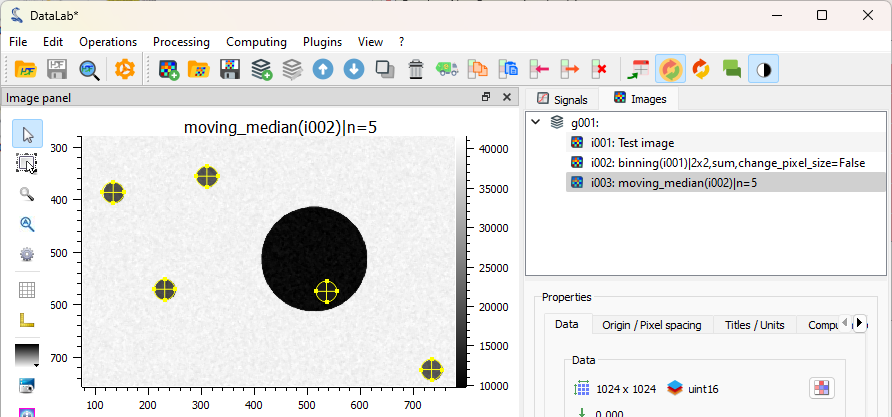
Automatic blob detection on a denoised test image in DataLab.#
Proof in production#
In the field of non-destructive testing, CEA entrusted CODRA with X-GRID, a software for the automatic reconstruction of radiographic scenes from partial X-ray images – with no prior metadata on position, orientation or magnification. Its processing pipeline (denoising, robust blob detection, homography estimation, image fusion) was prototyped interactively with DataLab before being integrated into the production tool. This work was presented at EuroSciPy 2026.
Try it#
No install: open DataLab-Web with a demo inspection image already loaded in your browser – your data never leaves your machine.
Step-by-step tutorial: Automated detection of defects and particles on images.